Configuration Drift in Distributed Systems: How Invisible Changes Accumulate Until Production Fails
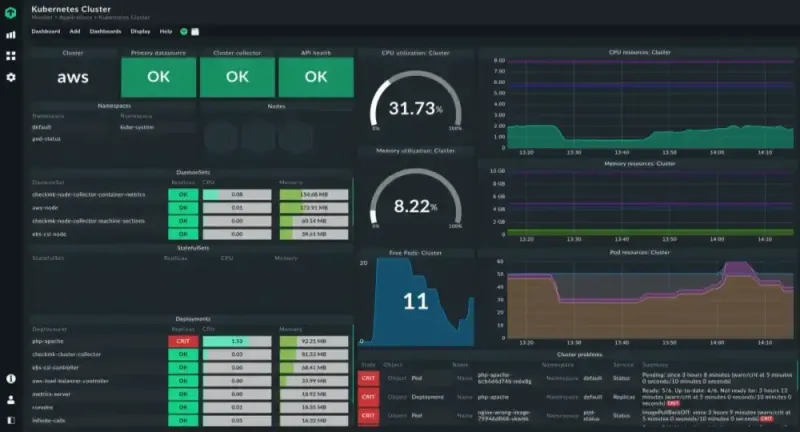
Photo: server infrastructure monitoring dashboard configuration management data center, via logit.io
There is a particular kind of technical debt that does not appear on any backlog, does not trigger any alert, and does not show up in any deployment log. It accumulates one small change at a time — a kernel parameter tuned manually on a single node, an environment variable updated directly in a staging console, a firewall rule added during an incident and never removed. By the time it surfaces, it has usually already caused a production failure.
Configuration drift is one of the most underestimated operational hazards in modern infrastructure. The irony is that teams who have invested heavily in infrastructure-as-code tooling often feel protected from it. In practice, that protection has significant blind spots.
Why IaC Coverage Does Not Equal Drift Prevention
Infrastructure-as-code platforms like Terraform, Pulumi, and AWS CloudFormation are valuable for codifying intended state. But they operate on a fundamental assumption: that all meaningful configuration changes flow through them. In real-world environments, that assumption breaks down constantly.
Consider a few common scenarios. A database administrator adjusts PostgreSQL memory settings directly on a production instance to resolve a performance degradation at 2:00 a.m. A developer updates an application environment variable through a cloud provider's console to test a configuration change without going through a full deployment cycle. A security engineer modifies an IAM policy inline rather than through a Terraform module because the change is time-sensitive. None of these actions are inherently malicious or even careless. But none of them are captured by your IaC state files either.
Terraform's terraform plan will show no drift because the change was never managed by that configuration block. Drift detection features in tools like Terraform Cloud or AWS Config only flag divergence from the last known managed state — not from the broader intended architecture. The result is a growing class of configuration changes that exist in production but nowhere else.
The Compounding Effect Across Distributed Systems
In a monolithic environment, configuration drift is painful but contained. In distributed architectures — microservices, multi-region deployments, Kubernetes clusters with dozens of node pools — the compounding effect becomes genuinely dangerous.
Each service may carry its own runtime configuration. Feature flag states, connection pool limits, timeout values, TLS certificate paths, log verbosity levels: these settings are often managed independently across services with no centralized audit trail. When a configuration value diverges between two instances of the same service, the behavior difference may be subtle enough to escape functional testing but severe enough to cause cascading failures under load.
One pattern that appears repeatedly in post-incident reviews is what might be called configuration skew between environments. A setting that was intentionally lowered in staging to reduce resource consumption never gets updated in production. Or the reverse: a production-specific tuning parameter is replicated into a pre-production environment, masking real performance characteristics during load testing. When the deployment finally reaches production, the assumed configuration and the actual configuration are different documents.
Detection Mechanisms Beyond Traditional Tooling
Addressing drift effectively requires detection mechanisms that operate independently of your deployment pipeline. Several approaches deserve consideration.
Runtime configuration snapshots involve periodically exporting the live configuration state of your infrastructure components — not from your IaC state files, but directly from the running systems themselves. For cloud environments, this means querying AWS Config, GCP Asset Inventory, or Azure Resource Graph on a scheduled basis and comparing the output against a known baseline. Divergences trigger alerts before they become incidents.
Agent-based host auditing tools like Chef InSpec, Ansible's audit mode, or open-source options such as osquery allow teams to write declarative specifications of expected system state and continuously verify compliance against them. Unlike IaC tools, these operate at the host level and can detect changes to kernel parameters, installed package versions, file permissions, and running process configurations — the exact class of changes most likely to be made manually during an incident.
Secrets and environment variable auditing is an area that often receives insufficient attention. Platforms like HashiCorp Vault provide audit logging for secret access, but the configuration values injected into running containers or virtual machines at startup are rarely re-verified after deployment. Integrating environment variable snapshots into your observability pipeline — even as structured log entries — creates an audit trail that would otherwise not exist.
Kubernetes admission controllers and policy engines such as OPA Gatekeeper or Kyverno provide a different class of protection: they enforce configuration policy at the point of change rather than detecting drift after the fact. For teams running containerized workloads, these tools represent a meaningful shift from reactive detection to proactive prevention.
Building a Continuous Configuration Auditing Framework
Detection tooling is only as useful as the operational process surrounding it. A framework for continuous configuration auditing typically involves four components.
First, establish a canonical configuration baseline. This is not your IaC state file in isolation — it is a composite document that includes IaC-managed resources, runtime configuration values, host-level settings, and application configuration parameters. The baseline should be version-controlled and updated through a deliberate review process, not automatically overwritten by whatever is currently running in production.
Second, implement scheduled reconciliation checks that compare live state against the baseline and produce structured output. The output should be routed into your existing alerting infrastructure rather than a separate dashboard that no one monitors. Configuration drift that does not generate an actionable alert is effectively invisible.
Third, define a drift severity classification. Not all divergences carry equal risk. A changed log verbosity level is operationally different from a modified security group rule. Your alerting and escalation logic should reflect that distinction, routing high-severity drift to on-call engineers and lower-severity findings to a weekly review queue.
Fourth, enforce a remediation SLA. Configuration drift that is detected but not remediated within a defined window should escalate automatically. This closes the loop between detection and resolution and prevents the common failure mode where drift reports are generated, acknowledged, and then quietly ignored until they contribute to an incident.
The Operational Debt That Accumulates in Silence
Teams that lack a continuous auditing practice tend to discover their configuration debt in the worst possible context: during an active incident, when the pressure to restore service conflicts directly with the need to understand what changed and when. Post-incident reviews frequently surface configuration divergences that had existed for weeks or months before the triggering event — divergences that were, in retrospect, entirely detectable.
The investment required to build adequate configuration visibility is not trivial. It requires tooling, process discipline, and ongoing maintenance as your infrastructure evolves. But it is a substantially smaller investment than the compounded cost of repeated production incidents, extended mean time to resolution, and the erosion of team confidence that follows each one.
Configuration drift is not an edge case. In any environment where humans have operational access to production systems — which is to say, virtually every production environment — drift is the default state. The question is not whether it is happening, but whether you have built the instrumentation to see it before it breaks something you cannot afford to have broken.