Automation Blindness: How Your CI/CD Pipeline Hides Operational Failures in Plain Sight
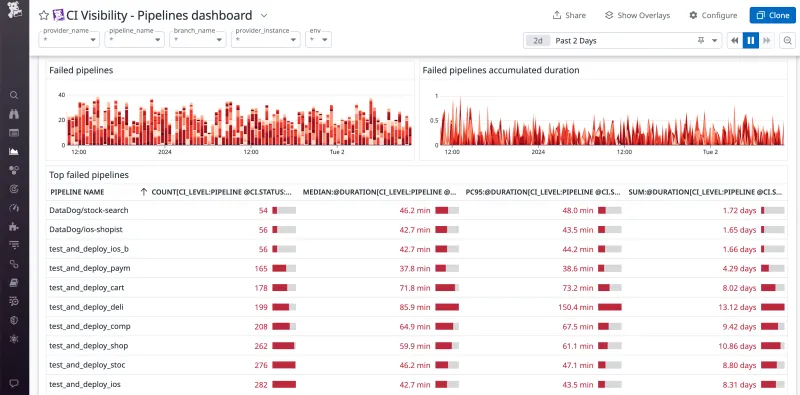
Photo: CI/CD pipeline dashboard automation server monitoring, via imgix.datadoghq.com
There is a particular kind of confidence that comes from watching a deployment pipeline complete without a single red indicator. Green checkmarks cascade down a dashboard, Slack notifications confirm a successful rollout, and the on-call engineer closes their laptop for the evening. Everything looks healthy. The system, however, may be quietly unraveling.
This is the operational trap that mature engineering teams rarely discuss openly: the more sophisticated your deployment automation becomes, the more effectively it can obscure the signals that precede catastrophic failure. CI/CD pipelines are designed to abstract complexity—and that abstraction, left unexamined, becomes a liability.
The Confidence Gap Between Deployment Success and Operational Health
Deployment automation solves a real problem. Manual release processes introduce human error, slow down delivery cadence, and create inconsistent environments. The shift toward automated pipelines has unambiguously improved software reliability in most organizations. The problem is not automation itself—it is the implicit assumption that a successful deployment equals a healthy system.
Consider what a typical CI/CD pipeline actually validates. It confirms that the build artifact compiled without errors. It verifies that a defined suite of tests passed. It checks that the deployment target accepted the new configuration. What it does not inherently validate is whether the application is behaving correctly under real production load, whether dependent services are degrading, or whether a configuration change introduced a latency regression that will only surface at scale.
This confidence gap—between what automation certifies and what operations actually requires—is where silent failures incubate.
Real-World Failure Patterns That Automation Masks
The Gradual Degradation Deployment
One of the most common scenarios involves a change that passes all pre-deployment gates but introduces a memory leak or connection-handling inefficiency that only manifests after several hours of sustained traffic. Automated deployment declares success at T+0. The on-call team receives a page at T+6 hours when memory pressure finally exhausts available headroom. Because the deployment completed cleanly, the connection between the release and the incident is not immediately obvious. Teams frequently spend the first thirty minutes of an incident ruling out infrastructure causes before returning to the deployment log.
The automation did not cause the failure. But it created the conditions for delayed attribution, which directly extends mean time to resolution.
The Canary That Nobody Watched
Canary deployments are widely regarded as a best practice for reducing blast radius. They are, in principle, an excellent mechanism for catching production-specific failures before they affect all users. In practice, many teams configure canary stages without defining meaningful promotion criteria. The canary advances automatically after a time threshold rather than after validated signal.
When the promotion criterion is simply "no deployment-level errors in the past ten minutes," the canary stage provides a false sense of validation. Application-level error rates, p99 latency, and downstream service health are not part of the gate. The automation promotes anyway, and the degraded behavior scales to full production traffic.
Configuration Drift Deployed at Scale
Infrastructure-as-code pipelines face a related but distinct problem. When environment configuration is managed through automation, small parameter changes—a timeout value, a thread pool size, a feature flag default—can be deployed across dozens of services simultaneously. Each individual change is negligible. The aggregate effect under production conditions may be substantial. Because the pipeline treats configuration changes with the same success criteria as application deployments, there is no mechanism to flag that this particular combination of changes has never been validated together.
Building Observability Into the Deployment Process Itself
The conventional approach to this problem is to improve post-deployment monitoring: add more dashboards, tighten alerting thresholds, extend the observation window after releases. This is necessary but insufficient. The more durable solution is to treat the deployment pipeline as an observable system in its own right.
Define Deployment-Specific SLOs
Most teams define Service Level Objectives for their applications in steady state. Fewer define them for the deployment window. Establishing explicit success criteria for the period immediately following a release—covering error rate delta, latency percentile shift, and saturation metrics relative to the pre-deployment baseline—creates a structured mechanism for detecting regressions that the pipeline itself cannot see.
These deployment SLOs should be integrated directly into the promotion logic for staged rollouts. An automated gate that blocks promotion when p95 latency increases by more than fifteen percent is meaningfully different from one that simply counts HTTP 5xx responses.
Instrument the Pipeline as a Telemetry Source
Deployment pipelines generate rich operational data that most teams discard or store in isolation. Build duration trends, test flakiness rates, artifact size growth, and rollback frequency are all leading indicators of systemic health. A team that deploys twice a day and rolls back once a week has a fundamentally different risk profile than one with the same deployment frequency and no rollbacks—but both may report identical uptime metrics.
Integrating pipeline telemetry into the same observability stack used for application monitoring creates a unified view that enables correlation. When an incident occurs, engineers can immediately assess whether a deployment event preceded the degradation, without manually cross-referencing separate systems.
Require Explicit Health Verification Steps
Every deployment pipeline should include a post-deployment verification stage that is distinct from the deployment action itself. This stage should execute synthetic checks against production endpoints, validate that dependent service integrations are responding within expected parameters, and confirm that background job queues are processing normally. The verification step should have its own timeout and failure mode—a verification timeout should be treated as a deployment failure, not a neutral outcome.
This pattern is straightforward to implement in most pipeline platforms and provides a meaningful check against the class of failures that only manifest in the live environment.
Shifting the Mental Model
The underlying cultural shift required here is treating deployment automation as an operational system that requires its own monitoring, not merely as a mechanism for delivering application changes. Pipelines fail in ways that are distinct from application failures—they time out, they skip stages under certain error conditions, they accumulate technical debt in the form of untested edge cases in promotion logic.
Engineering teams that apply the same rigor to their deployment infrastructure as they do to their production services are significantly better positioned to detect the slow-moving failures that automation otherwise conceals. The green checkmark is a starting point for operational confidence, not the conclusion of it.